
IV…“forgetthefactimlarping”
Spend enough time online and you start to notice something strange about identity.


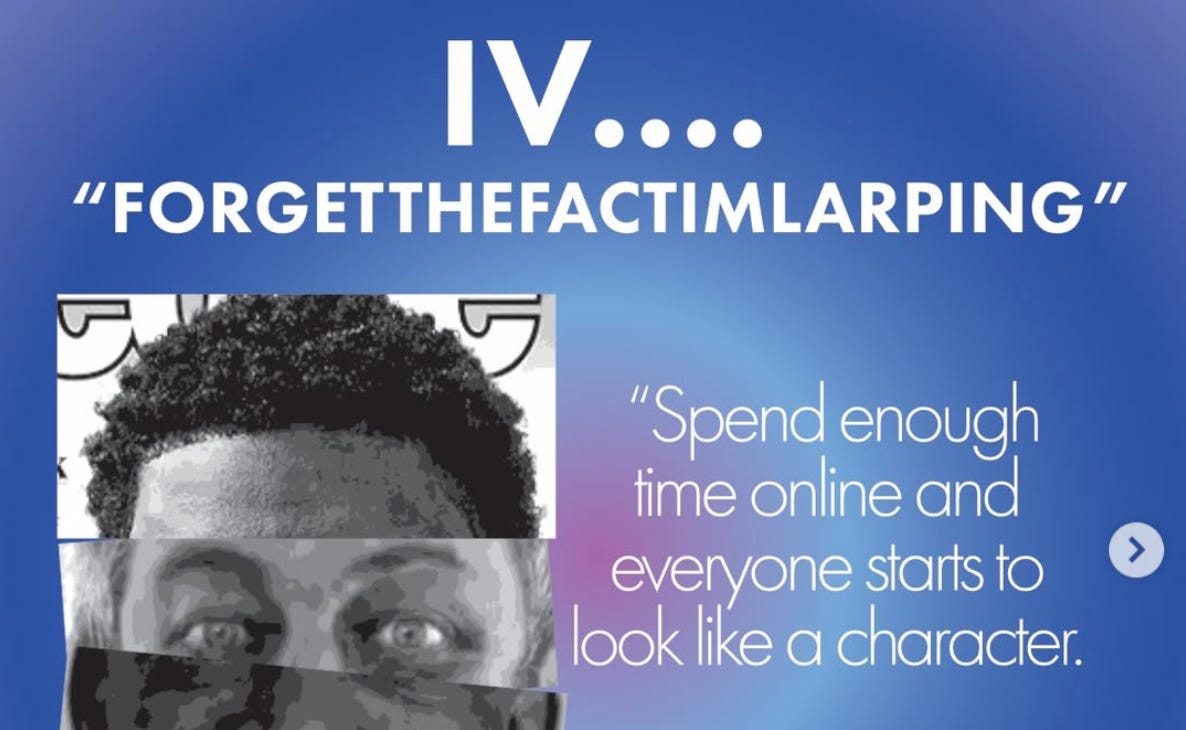
<p>Have you or someone you know felt like you were playing a character, but in real life? Larping, when someone is pretending to be something they’re not, can involve lying on social media/the internet or lying in real life. Often used in a derogatory sense. Spend enough time online and you start to notice something strange about identity. Certain personalities repeat. The nonchalant one. The villain. The mysterious girl. The lover boy. They don’t feel random — they feel recognizable, almost pre-written. The internet compresses people into patterns that are easier to understand, easier to recognize, and easier to perform. And after a while, it becomes difficult to tell whether people are expressing who they are, or stepping into roles that already exist. This is larping. And this way of thinking doesn’t stay online. It starts to shape how people move through everyday interactions — how they approach relationships, how they interpret behavior, even how they decide who they’re supposed to be to someone else. Instead of meeting people as they are, it becomes easy to place them into roles you already recognize, and respond accordingly.
These roles don’t appear out of nowhere. They usually form around shared interests like music, art, aesthetics, ways of thinking that people naturally gravitate toward. Someone listens to certain artists, watches certain films, engages with certain ideas, and over time those influences begin to shape not just what they like, but how they present themselves. The role starts to feel like a reflection of something real. But with that recognition comes a quiet pressure. Once you begin to identify with a certain archetype, it becomes easy to feel like you have to embody it completely not just in what you post, but in how you think, how you move, how you respond to people, even how you spend your time. What starts as alignment with a set of interests slowly turns into an expectation to live up to everything that identity represents.
Before the internet, being something usually required being seen as it in specific moments. An artist made art, showed it, performed it — but there was still space in between where the role could exist quietly. Now that boundary feels almost nonexistent. To be an artist online is not just to create, but to embody the identity constantly through what you post, how you speak, what you show yourself consuming, even how you move through your daily life. The role extends beyond the work itself. And it’s not limited to art. The same pattern shows up in more traditional paths too — people building careers around interests, curating their lives into something that can be recognized as a portfolio, not just for employers, but for anyone watching. A skill, a passion, a way of thinking becomes something that has to be visible, consistent, legible at all times. The line between doing something and being seen as someone who does it begins to blur. Which raises a quieter question underneath all of it: if the identity has to be maintained constantly, if the performance never really turns off, then what is the thing itself for? If the goal is simply to be comfortable while doing something you enjoy, at what point does the need to be seen doing it begin to change the reason you started?
The answer isn’t always clear, because the mentality around it is complicated. For some, the visibility feels like an opportunity — a way to be recognized, to turn something they care about into something sustainable. For others, it becomes harder to separate the work from the way it’s received. The process starts to blur with the presentation of it. You begin to think not just about what you’re doing, but how it will be seen, how it will be understood, how it fits into the identity you’ve built. And within the community itself, that awareness doesn’t exist in isolation. There are signals that encourage it — recognition, engagement, shared language, the small moments where someone acknowledges that you “fit” within a certain space. Participation becomes more than just doing the thing; it becomes being seen doing it in a way that others recognize. People support each other, but they also reinforce their roles, consciously or not. The more legible your identity is, the easier it is for others to engage with you, and the easier it becomes to stay within that pattern. Over time, being part of the community can start to feel like maintaining a version of yourself that others already understand. At a certain point, participation and performance start to blur together — not in a way that feels dishonest, but in a way that feels understood. Like everyone is aware, on some level, that they’re larping — but that awareness doesn’t stop the role from feeling real. And in that space, it becomes easy to mistake being recognized for being understood like everyone knows the role being played, but agrees not to question it too closely.
As an artist, I think about this tension constantly. Being from Detroit and working on my own music, I’ve started to notice how identity and performance don’t just exist online — they exist in the way art is made and received. Rap has always carried archetypes — the hustler, the survivor, the villain, the philosopher. Those roles helped artists communicate something real about where they came from. But now, there’s an added layer of awareness. It’s not just about embodying a role, it’s about knowing that you’re embodying it while other people are watching.
That tension is something I’ve been exploring on my mixtape gardenbetaver.1. One of the songs is called “...forgetthefactthatimlarping.” It plays on that quiet agreement that seems to exist now — where people understand that some part of identity is performance, but still choose to move through it sincerely. The idea isn’t to call anything fake. It’s to sit in that space where both things can be true at once — where the role is being played, but the feelings inside it are still real. And maybe that’s the question I’ve been left with: not whether we’re performing, but what we’re actually trying to hold onto while we do.</p>
 | A guest post by
|